


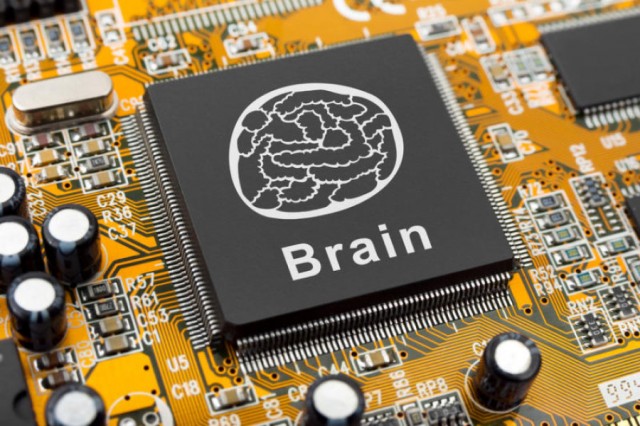
The Defense Advanced Research Project Agency (DARPA) sedang dalam proses pembuatan chip pengendali-saraf yang mampu mengendalikan anggota badan buatan ketika disambungkan dengan otak. Perangkat ini telah berhasil diujicobakan pada binatang dan uji coba pada manusia akan dilaksanakan pada tahun 2017. Pentagon memberikan subsidi kepada institusi ini sebesar US$ 62 juta untuk membantu pengembangan teknologi pengendali pikiran ini. Sementara itu, media-media mainstream sedang mendesakkan agenda pemasangan mikrochip pada anak-anak lebih cepat daripada sebelumnya.
Dalam laporan televisi terbaru NBC News, stasiun berita ini menayangkan berita utama pemasangan mikrochip pada anak-anak oleh pemerintah sebagai sesuatu hal yang normal, seperti halnya penggunaan barcode untuk konsumen,
"Pada waktu barcode pertama kali muncul pada akhir tahun 1960-an, orang-orang gempar. Mereka sangat was-was terhadap hal itu dan tidak memahami konsepnya. Sekarang, itu sudah menjadi begitu umum, kita bahkan tidak menyadarinya lagi. Mikrochip juga akan berfungsi dengan cara yang hampir sama."
Pernyataan ini mencerminkan mentalitas dari media mainstream, yang memandang manusia sebagai obyek yang cocok untuk dipasangi label, dan bukannya sebagai pribadi yang memiliki nilai-nilai moral intrinsik. Meskipun DARPA menggembar-gemborkan chip otak ini sebagai jalan untuk melindungi anak-anak, tetapi sebenarnya, teknologi semacam ini lebih berperanan untuk pengendalian manusia, dan bukannya untuk keamanan publik.
Pengendalian Massa
Kapan pun pemerintah ingin mengendalikan massa, mereka menyusun daftar poin-poin untuk menakut-nakuti masyarakat sehingga bisa diatur menurut agenda mereka. Kapan pun media-media mainstream mendesakkan program vaksinasi, contohnya, mereka menyusun daftar semua kemungkinan-kemungkinan bagaimana seseorang dapat menjadi sakit dan mati jika mereka tidak disuntik vaksin, tanpa mengungkapkan efek sampingnya (CDC menyembunyikan data yang menunjukkan vaksin dapat meningkatkan resiko autisme hingga 340%). Dan kapan pun pemerintah ingin menggerogoti hak-hak pribadi, mereka melakukan itu dengan memberi judul "melindungi" masyarakat dari "teroris" atau "orang jahat."
Beberapa pemilik hewan kesayangan sudah mulai memasang chip pada anjing-anjing mereka supaya bisa tetap dilacak keberadaannya. Karena itu, para pendukung mikrochip berargumentasi, tidak terlalu berlebihan untuk mulai memasang mikrochip pada bayi-bayi yang baru dilahirkan untuk tujuan yang sama.
Menurut pernyataan DARPA, chip otak dapat:
"[Memungkinkan] bandwidth transfer data antara otak manusia dengan dunia digital, memberi masukan informasi audio atau visual digital ke dalam otak." Dan karena itu "membuka jalur antara otak manusia dengan peralatan elektronik modern."
Dengan kata lain: Mereka mengembangkan chip pengendali pikiran yang dapat dimasukkan ke dalam otak bayi-bayi sejak mereka dilahirkan.
Seperti dijelaskan Waking Times, institusi militer menyebutkan istilah yang dinamakan "mission creep," yang memiliki pengertian perluasan proyek militer diluar tujuan aslinya yang akan membantu perluasan dukungan masyarakat. Jika militer ingin menginvasi suatu negara, contohnya, mereka pertama-tama akan mengambil alih wilayah-wilayah terdekat dan mendirikan markas militer di sekeliling negara yang hendak dikuasai dalam usaha untuk meningkatkan peluang kemenangan. Dengan cara yang sama orang-orang dikondisikan untuk perang-perang yang tidak berdasar, DARPA sekarang ini sedang berusaha memaksa publik untuk tunduk kepada program pengendali pikiran.
Google Mendukung Chip Pengendali Pikiran DARPA
Tahun lalu, CEO Google, Eric Schmidt, menghadiri konferensi Bilderberg bersama mantan pegawai DARPA dan eksekutif Google, Regina Dugan, dimana dia menyuarakan dukungannya terhadap teknologi DARPA.
"Jika Anda ingin melakukan sesuatu yang tidak Anda kehendaki siapa pun mengetahuinya, mungkin Anda tidak seharusnya mulai melakukan itu," kata Schmidt.
"Kami tidak butuh Anda menuliskan sesuatu sama sekali karena kami tahu Anda sedang ada di sini, dengan ijin Anda, kami tahu Anda sebelumnya dari mana, dengan ijin Anda, kami dapat kurang lebih menebak apa yang sedang Anda pikirkan," sambungnya.
Menambahkan pernyataan tersebut, Schmidt secara spesifik menyinggung chip otak DARPA dalam wawancara yang sama.
"Ini yang aku sebut batas yang menakutkan dan kebijakan Google dengan sejumlah besar hal-hal seperti ini adalah untuk sampai ke batas itu, tapi tidak melewatinya. Aku berpendapat bahwa mengimplan sesuatu ke dalam otak Anda itu diluar batas yang menakutkan… setidaknya sekarang ini sampai teknologinya menjadi lebih baik."
Wahyu 13:16-17 (ILT) Dan dia (nabi palsu itu) membuat semua orang, kecil dan besar, juga kaya dan miskin, bahkan merdeka dan hamba, supaya dia memberikan kepada mereka sebuah tanda (Yunani: charagma; stempel, goresan, tanda yang dicetakkan, sesuatu yang diukirkan/dibentuk/dilukiskan) pada tangan kanan mereka atau pada dahi mereka. Dan supaya setiap orang tidak dapat membeli atau menjual, kecuali dia yang mempunyai tanda atau nama binatang itu atau bilangan namanya.
Referensi:
We Will Microchip Your Children
******************************
In both science and science fiction, the pinnacle of human evolution is a brain that connects directly to a computer.
We’re not quite there yet, though scientists have made significant headway in using chips implanted in human brains, known as brain-machine interfaces, as the neural equivalent of a prosthetic limb, targeting damaged areas of the brain to achieve things like restoring mobility to patients who are paralyzed. A significant hitch is that implanting such devices is the brain is incredibly risky. But now scientists at DARPA, the Department of Defense’s research arm, have pioneered a method of chip implantation that’s less invasive—and that could lead to an expansion of the use of brain-machine interfaces.
DARPA
The "stentrode," developed by DARPA researchers, will make it less risky to implant chips in the brain.
 In an article published Monday in Nature Biotechnology, researchers at the University of Melbourne working under DARPA’s Reliable Neural-Interface Technology (RE-NET) program describe a study in sheep that recorded signals from the motor cortex of the brain (which controls movement) using a new device they’ve dubbed the “stentrode.” The stentrode can be implanted into the brain through blood vessels without even opening the skull, eliminating the need for the sort of invasive surgery required to implant traditional electrode arrays.
Instead, researchers insert the device via a blood vessel in the neck, then guide it to the appropriate location in the brain using real-time imaging. Once in place, the device expands and attaches to the walls of the blood vessel to read the activity of nearby neurons. In past studies, DARPA and other scientists have successfully demonstrated that paralyzed patients outfitted with electrode array brain implants that intercepted the brain’s electrical signals in a similar way could move prosthetic limbs.
Researchers are planning a human trial of the stentrode next year. If it’s successful, it could be a very big deal, effectively eliminating the biggest risk in implanting brain-machine interfaces, which is open brain surgery.
A recent Wired profile of neurologist Phil Kennedy, a pioneer in the realm of brain machine interfaces, revealed just how dangerous implanting the devices can be. Kennedy, eager to test his device on a healthy brain, flew to Belize to have his own device implanted in himself. Due to swelling in his brain, his recovery at first went poorly, rendering him unable to really speak for days. And after just 88 days, he had to have his bulky implant removed.
Kennedy envisions a future in which brain chips will be a normal thing for all humans. He told Wired:
“The first goal is to get the speech restored. The second goal is to restore movement, and a lot of people are working on that—that’ll happen, they just need better electrodes. And the third goal would then be to start enhancing normal humans.”
Eventually, Kennedy said, we’re all going to “extract our brains and connect them to small computers that will do everything for us, and the brains will live on.”
DARPA is also exploring using brain chips to treat PTSD and to help soldiers returning from war with traumatic brain injuries impacting memory. In other instances, DARPA’s ambitions for neural prosthetics veer a little more toward sci-fi, like, as Annie Jacobsen describes in her recent history of DARPA, using implants to allow soldiers on the battlefield to communicate by thought alone.
But, as Wired’s profile of Kennedy points out, invasive brain implants are also going out of style. Instead, research has begun favoring electrocorticography, which involves laying a flat surface of electronics on top of the brain to capture less detailed information than invasive implants might. DARPA’s new method, if successful, could offer a third option: a way of measuring detailed signals without having to open up the skull at all. And that will make us all one step closer to living on forever as disembodied brains in a vat.
******************************
DARPA Spent $62 Million Creating Microchips For Humans
The Defense Advanced Research Projects Agency (DARPA) is in the process of making a neural-coding device capable of controlling artificial limbs when seeded in the brain. The device has had success in animal studies and the first human trials are set for 2017. The Pentagon has subsidized the institution $62 million to help foster this mind-control technology. Meanwhile, the mainstream media is pushing for the micochipping of children sooner rather than later.
During a recent televised report by NBC News, the news station purported the micro-chipping of children by the state was as normal as bar codes for consumers: “When barcodes first came out in the late 1960s, people were appalled. They were wary of them and did not understand the concept. Today, it is so commonplace, we don’t even notice it. A microchip would work much in the same way.”
This declaration is a reflection of the mentality of the mainstream media, which sees people as objects fit for labeling rather than persons with intrinsic moral value. Although DARPA touts the brain chips as a way to protect children, in actuality, this sort of technology has more to do with control than it does public safety.
Controlling the masses
Whenever the establishment wants to control the masses, they assemble a list of cheap talking points to scare the population into abiding by its agenda. Whenever the mainstream media pushes for vaccines, for instance, they list all the possible ways a person may become very sick and die if they don’t get the shot. And whenever the government wishes to corrode privacy rights, they do so in the name of “protecting” the public from would be “terrorists.”
Several pet owners have already microchiped their dogs to keep tabs on their pets. Therefore, microchip proponents argue, it is not too much of a stretch to start micro chipping children at birth for similar purposes. The problem is most people are not aware of the dangers this reasoning poses, which is why mind-control technology is not being more widely opposed.
According to a statement made by DARPA, the brain chip would:
“[Enable] data-transfer bandwidth between the human brain and the digital world, feeding digital auditory or visual information into the brain.” and thereby “open the channel between the human brain and modern electronics.”
In short: They are developing mind control chips that can be inserted into the brains of babies from the cradle.
As the Waking Times explains, the military deploys a term known as “mission creep,” which refers to the expansion of a military project beyond its original goals that has yet to foster public support. If the military wants to invade a country, for example, they will first take over nearby regions and establish a military base around the desired country in an effort to boost the likelihood of winning. In the same way the public has been coerced into a number of unjustifiable wars, DARPA is now trying to coerce the public into submitting to mind control.
Google endorses DARPA mind control chips
Last year, CEO of Google, Eric Schmidt, attended a Bilderberg conference with former DARPA employee and Google executive Regina Dugan, where he voiced support of DARPA’s technology.
“If you have something that you don’t want anybody to know, maybe you shouldn’t be doing it in the first place,” Schmidt said.
“We don’t need you to type at all because we know here you are, with your permission, we know where you’ve been, with your permission, we can more or less guess what you’re thinking about,” he continued.
Adding to these remarks, Schmidt specifically referred to DARPA’s brain chips in the same interview.
“There’s what I call the creepy line and the Google policy with a lot of these things is to get right up to the creepy line, but not cross it. I would argue that implanting things in your brain is beyond the creepy line…at least for the moment until the technology gets better.”
Without doubt, the mainstream media and DARPA will continue to tout the benefits of this technology without noting all the risks. Due to this, it is on the shoulders of the alternative media to ensure the public isn’t trolled by mind control.
Sources include
Tidak ada komentar:
Posting Komentar
Catatan: Hanya anggota dari blog ini yang dapat mengirim komentar.